AI
The Org Chart Is About to Get Weird
How many tokens should your accountant get?
19 August 2026
What about your marketing manager? Your lawyer? Your junior analyst?
Companies are already putting limits around how much AI employees can use. Today, we mostly treat those limits as an IT or cost-control decision.
But there is a more interesting question hiding underneath.
What happens to the organisation when AI stops being just another tool and starts becoming an active participant in how work gets done?
An accountant might have an agent reconciling transactions. A marketing manager might have another continuously monitoring competitors. A salesperson could have an agent researching prospects, preparing meetings and following up afterwards.
The employee is still there.
But the employee is no longer working alone.
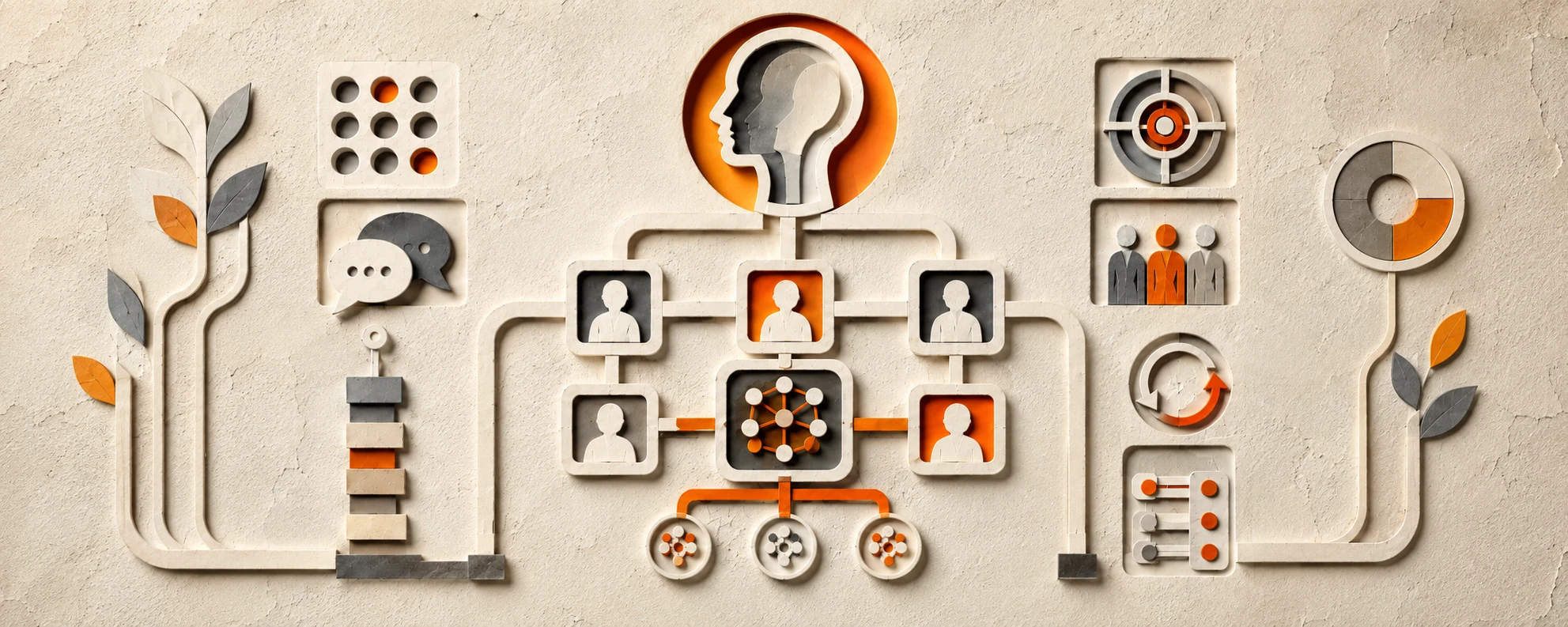
The boxes aren’t just people anymore
The traditional org chart is remarkably simple.
People sit inside boxes. Lines between those boxes represent authority and responsibility.
Software doesn’t appear because software doesn’t participate in the hierarchy. Excel doesn’t manage the accountant using it.
Agents are different.
Imagine five employees reporting to a manager, with each employee operating several agents. Some agents belong to individuals. Others serve the whole team. Another monitors performance, identifies risks and nudges people when projects fall behind.
What exactly does that org chart look like?
I don’t know.
But I doubt it looks like the one hanging on the HR department’s wall today.
Below you, beside you and above you
We often talk about AI as if its place in an organisation is obvious: it sits below the human and performs tasks.
That may only be one relationship.
AI could sit below us as an agent, executing work we delegate.
It could sit beside us as a collaborator, helping us think and challenging our assumptions.
And it could sit above us as a coach or manager, monitoring progress, reminding us of commitments and pushing us when work falls behind.
The same AI could move between all three roles during a single day.
In the morning, it researches something for me.
During a meeting, it challenges an assumption.
In the afternoon, it tells me I’m spending time on the wrong thing.
That’s very different from using software.
The coach and the micromanager
This is where things become uncomfortable.
Imagine every employee has a personal AI coach.
It attends meetings. Understands projects. Remembers commitments. Helps prioritise work. Notices patterns in how someone works.
That could be incredibly empowering.
But almost everything that makes it a great coach also makes it a great micromanager.
It knows which deadlines I missed. Which commitments I ignored. Which projects are falling behind. Eventually, it might know how my performance compares with thousands of people doing similar work.
So who gets access to that?
My manager? HR? Only me?
The difference between an AI coach and an AI micromanager may simply be who gets access to the data.
And that creates another organisational relationship we haven’t really had before.
An AI might work for the company while simultaneously being expected to earn the trust of the employee.
I’m not sure those two roles can always coexist.
What happens to the manager?
If AI can coordinate work, monitor progress, summarise meetings, identify blockers and remind people of commitments, some traditional management work becomes easier to automate.
That doesn’t mean managers disappear.
Their job may simply shift.
A manager responsible for five employees might eventually be responsible for five humans operating twenty agents.
Instead of constantly asking Where are we with this?, the more important question becomes:
Is this system producing the right outcome?
Managers may spend more time deciding what humans should do, what agents should do, where human judgment matters, what an agent is allowed to act on and when it needs to escalate.
Management starts looking less like supervision and more like system design.
And perhaps that is the bigger change.
The organisational chart was designed for a world where almost every meaningful actor inside a company was human.
That assumption is starting to change.
AI can now sit below us as an agent, beside us as a collaborator and increasingly above us as a coach or manager.
I don’t know what the org chart of an AI-native company will eventually look like.
But the interesting question isn’t where AI sits on the org chart.
It’s what happens to the org chart when AI can sit almost anywhere.
- Filed
- 19 August 2026